
How to Sell Trading Cards on eBay Like a Pro: Turn Your Pokémon, One Piece, and MTG Cards into a Side Hustle

Every trading card collector dreams of turning their extra inventory into clean, reliable profit. You pull a beautiful Special Illustration Rare or a high-end Magic Surge Foil, head to eBay with high hopes, and list it for sale.
But let's be honest. I can tell you from decades of personal experience, the enjoyment of trying to make money with a hobby that you love can come with some real headaches.

One day you open your account only to find your hard-earned profit eaten alive by unexpected platform fees and shipping costs. Or worse, a buyer opens a dispute claiming a "pack-fresh" card was damaged, or lost in the mail leaving you out of both the card and the cash. It feels incredibly frustrating to do everything right, only to watch the system work against you.
You shouldn't need a business degree just to safely sell a piece of cardboard.
As a veteran seller who has shipped literally thousands of trading cards across Pokémon, One Piece, and Magic: The Gathering, I’ve made every mistake in the book so you don't have to. Usually twice, so I understand how stressful it is to navigate dishonest buyers, complex shipping rules, and platform policies.
That is why I built a proven, repeatable system that protects your margins, eliminates buyer disputes, and secures your hard-earned payouts.
Here is the simple, four-step plan to take control of your eBay storefront.
How to Sell Trading Cards on eBay
The Margin Protection Plan
How Much Should You Charge For eBay Shipping?
To win, you must treat different cards with different levels of armor. Treating a $15 Pokémon Foil the same as a $300 One Piece Manga is a guaranteed recipe for a loss. Use this simple chart to route your inventory automatically:
Just one note from personal experience: be very aware of the pros and cons of Standard Envelope shipping. That low cost selling point comes with some real risks that have cost me quite a bit of money.
Defeat the "Net Profit" Trap
The hidden villain of eBay is the fee stack. Casual sellers price cards based on the raw item value, forgetting that eBay calculates its final value fee from the total transaction amount (including item cost, shipping, and local sales tax).
The Math: Expect a baseline fee of 12.35% to 13.25% depending on your store tier, plus a flat $0.30 to $0.40 per-order fee, and a tiny 0.35% regulatory surcharge.
The Strategy: Always use the Product Research tool inside your eBay Seller Hub rather than general active listings. Active listings are what people hope to get; completed sales reveal exactly what buyers are actually paying right now.
Checking the Listing Condition of Your Cards
The quickest way to a forced return is overgrading your card. Never call a raw single "Mint" or "Gem Mint" just because it came straight out of a booster pack. Factory lines introduce subtle print lines, edge whitening, and off-center cuts that collectors notice instantly.

Position an angled LED light to check the surface, take macro photos of all four back corners, and include this exact script in your description to set clear expectations:
Please review all high-resolution photographs carefully. The card shown is the exact item you will receive. It is sold as a raw single; no specific professional grade is guaranteed.
How to Package Your Cards for eBay Shipping
For cards under $20, the eBay Standard Envelope is your greatest tool, but it must remain flexible and under 1/4-inch thick to pass through automated postal sorting machines.

For cards over $20, or for orders containing multiple singles that exceed the thickness rules of an envelope, the plain paper envelope is no longer an option. You must step up your armor to a USPS Ground Advantage parcel.
The goal shifts from flexibility to absolute rigid defiance, ensuring the package can survive heavy boxes stacking on top of it without bending, warping, or puncturing.
How Much Should You Price Your TCG Cards? Find the True Value of Your Listing
Pricing is the exact moment where many eager card sellers accidentally sabotage their own story. The internal villain here is sentimentality—assuming a card is worth more simply because you pulled it yourself or because it looks beautiful in your hands. The external villain is the active listing illusion.
If you price your inventory based on what other sellers are asking for their cards on eBay, you are looking at a mirage. Anyone can list a $5 Pokémon ultra-rare for $500; that doesn't mean anyone is buying it.
To price like a pro and protect your cash flow, you must use data to anchor your numbers in reality. Here is the exact protocol to find a card's true market value:
Filter by "Completed & Sold" Items: When searching for your card on eBay, scroll down the left-hand filter sidebar and check the boxes for Completed Items and Sold Items. This instantly shifts your view from what people hope to get to exactly what buyers actually paid within the last 24 to 48 hours.
Leverage the eBay Product Research Tool: Inside your eBay Seller Hub, use the built-in Product Research tool (formerly Terapeak). This gives you access to months of deep historical sales data, volume metrics, and average selling price charts across Pokémon, One Piece, and Magic: The Gathering. It lets you spot whether a card's market value is actively trending up, crashing, or holding stable.
Cross-Reference with TCGplayer Market Value: For raw card singles, TCGplayer is the ultimate data anchor. Check the Market Price (which balances recent transaction data) rather than the "Listed Median" price. If an item has a massive gap between its TCGplayer market price and its recent eBay sold price, look at the shipping costs—often, a lower card price on eBay is simply balancing out a higher shipping charge.
The 10% Dynamic Range Strategy: Once you establish the true baseline market price, determine your listing strategy. If you want a quick liquidation to get cash back in your hand for fresh sourcing, price your card at 5% to 10% below market value under the "Buy It Now" format. If your card has clean centering and flawless edges, price it right at the market average and enable "Best Offer," allowing you to negotiate down to your true target margin.
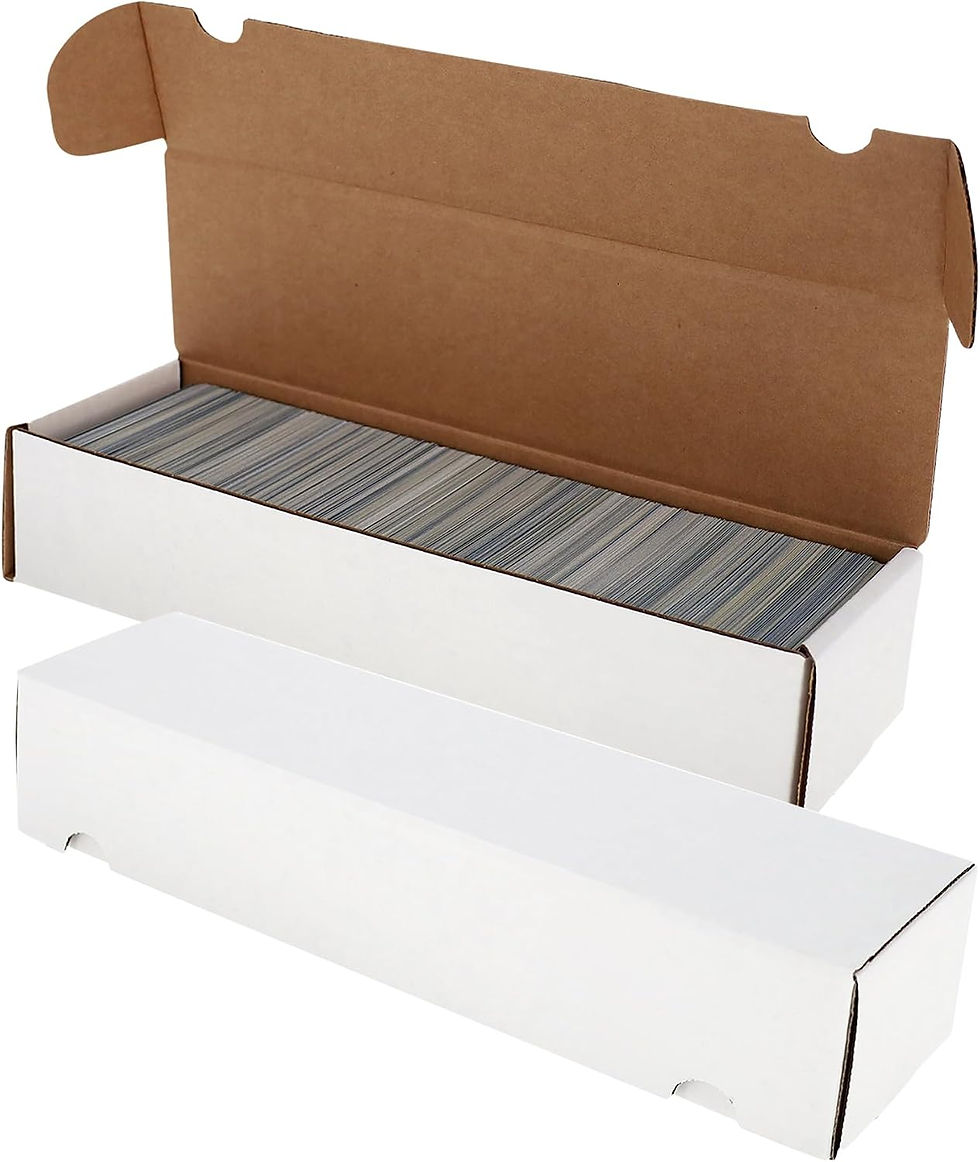
Essential Card Selling Supplies
Supply | Required to Start? | Why You Need It |
✅ Yes | Protect every card before shipping. | |
✅ Yes | The standard way to ship valuable singles. | |
Optional | Needed if you plan to submit cards for grading. | |
✅ Yes | Keeps the card securely inside the top loader. | |
Optional | Great for inexpensive cards and rigid protection. | |
✅ Yes | Ideal for higher-value cards and multi-card orders. | |
✅ Yes | Secures top loaders without sticky residue. | |
✅ Yes | Helps purchase accurate postage and avoid overpaying. | |
Optional | Speeds up shipping and eliminates ink costs over time. |
How to Replenish Your TCG Inventory
Every successful side hustle eventually hits a wall: you run out of cards from your personal collection to sell. Finding a steady stream of profitable inventory is the hardest obstacle a trading card seller faces. If you rely solely on paying full retail retail prices for booster boxes at local shops, your margins will vanish.
To keep your storefront alive, you must look where casual collectors aren't looking. Here is your map to the four major inventory hunting grounds, each requiring a completely different professional strategy:
Facebook Marketplace (The Bulk Arbitrage Game): This is where you find parents cleaning out closets or players looking for fast, zero-fee cash exits. You are hunting for unorganized "bulk lots." The strategy here is simple: you buy by the pound, and sell by the single. Look for listings with poor lighting and vague descriptions like "Big box of Pokémon cards." Sort through the noise to extract the hidden playable Magic staples, competitive One Piece uncommons, or popular character cards that the casual eye missed.
Card Shows (The Cash-in-Hand Edge): Card shows are unparalleled for sourcing because you can inspect conditions physically before spending a dime. Your best opportunity happens during the final afternoon of the convention. Dealers are exhausted, facing expensive packing friction, and looking to offset their travel costs. Bring cash, group multiple mid-to-high value singles together, and offer a bundled buyout price at 65% to 70% of market value.
Whatnot (The Late-Night Sourcing Hunt): Live stream auction apps run at a relentless pace. Smart flippers target "Sudden Death" auctions in smaller rooms (under 20 viewers) during off-peak hours, like a Tuesday after midnight. Streamers often run $1 starting bids to generate hype and algorithmic momentum; when the room is empty, high-end assets frequently sell for a fraction of their market price. Snatch these up, clean them up with professional photography, and list them on eBay at their true fixed value.
TCGplayer (The Misgraded Scan Market): TCGplayer is a high-volume
marketplace primarily run by text descriptions. Your target here is listings marked as "Lightly Played" or "Moderately Played" from sellers who don't upload photos. Large volume stores often grade conservatively to avoid complaints. Frequently, an "LP" card just has minor factory printing defects that don't hurt its visual appeal on an eBay listing, allowing you to buy at a deep discount and flip at a premium.
The Reddit Field Guide: Insider Secrets from Veteran Sellers
While understanding the mechanics of a listing is essential, navigating the unwritten culture of the eBay marketplace is what separates the casual flippers from the pros. Pulling directly from the collective wisdom of thousands of active sellers on communities like r/sportscards and r/baseballcards, here are the non-negotiable rules of engagement to keep your momentum high and your feedback flawless:
Never Build From Scratch (The "Sell One Like This" Hack): Creating a listing from the ground up is a massive time-drain. Instead, search eBay for a completed, sold listing that perfectly matches your card, open it, and click the "Sell one like this" button. This automatically pre-fills 90% of the tedious item specifics (set name, card number, team, parallel attributes), leaving you to just drop in your custom photos and set your price.
The Over-$20 Auction Trap: If you run an auction for a raw card with cheap $1.50 eBay Standard Envelope (ESE) shipping, and a bidding war unexpectedly pushes the final price past $20, the listing instantly becomes ineligible for the envelope service. eBay will force you to upgrade to a tracked bubble mailer (USPS Ground Advantage) at a baseline of roughly $4.50. Don't panic, and never try to bill the buyer for the difference—bake those occasional $3 shipping adjustments into your overall business costs.
Drip-Feed the Algorithm: The eBay search engine rewards consistent, daily activity. Instead of spending your entire Sunday afternoon dumping 50 listings onto the platform all at once, save them as drafts and publish 3 to 5 cards every single morning. This steady stream of activity flags your account as highly active, boosting your visibility across all search results.
Embrace the Micro-Margin Mindset: Don't fall into the trap of only hunting for massive, hundreds-of-dollars "chase" cards. The true backbone of a profitable side hustle lies in moving a high volume of $2 to $10 parallels, inserts, and short prints. Stop trying to squeeze every single penny out of a card's theoretical value, accepting a reasonable offer gets your capital back in hand quickly so you can reinvest it into fresh inventory.
The Promoted Listings Tax: eBay will aggressively prompt you to promote your listings to increase visibility, often defaulting to a staggering 13% fee rate. Veteran sellers know this is a margin killer. Manually adjust your promotion rate down to a modest 2% to 4% if you use it at all; anything higher simply transfers your hard-earned side hustle profit straight back to the platform.
A Tale of Two Outcomes
The choice before you is simple, and the stakes are high.
If you choose to stick to the old, casual way of listing, you will continue to face the anxiety of unpredictable fees, the frustration of damaged mail, and the risk of losing your cash to avoidable buyer returns. Your passion for collecting will be weighed down by operational friction.
But when you execute this blueprint, everything changes. You will open your phone to clean, predictable payouts. You will print labels and pack orders with absolute confidence, knowing your inventory is completely safe from sorting machine damage and platform disputes. On high-end cards over $250, eBay’s mandatory Authenticity Guarantee steps in as your ultimate shield, verifying the card before it ever touches the buyer, making the sale permanent and your profit fully protected.
You can stop worrying about the system and start scaling your storefront like a professional.
Thornberry Media is a participant in the Amazon Services LLC Associates Program, an affiliate advertising program designed to provide a means for sites to earn advertising fees by advertising and linking to Amazon.com.

Comments