
Best Photo Light Boxes for Trading Cards, Figures & Collectibles (2026)

Good product photos do not require a full photography studio.
If you sell Pokémon cards, Magic: The Gathering cards, graded slabs, action figures, sealed TCG products, or other collectibles on eBay or other online marketplaces, a tabletop photo light box can make product photography much easier. The right setup gives you cleaner backgrounds, more consistent lighting, and better-looking listing photos without taking over your desk or requiring expensive camera equipment.
For most trading card and collectible sellers, the PULUZ 16-inch Photo Studio Light Box is our best overall pick. It is large enough for raw and graded cards, PSA slabs, Pokémon booster boxes, Elite Trainer Boxes, sealed TCG products, and smaller action figures without jumping to a 20- or 24-inch photography box you may not need.
If you mainly photograph Pokémon cards, sports cards, TCG singles, or graded cards for eBay listings, however, the smaller DUCLUS 12-inch Light Box makes more sense. It gives you plenty of room for cards and slabs while taking up less space on a seller workstation.
Affiliate Disclosure: Thornberry Media participates in the Amazon Associates Program. If you make a purchase through one of our Amazon links, we may earn a commission at no extra cost to you.
Best Photo Light Boxes at a Glance
Light Box | Size | Best For |
16" | Best Overall | |
12" | Trading Cards & Slabs | |
20" | Action Figures | |
24" | Larger Collectibles | |
~10" | Best Budget |
1. PULUZ 16-Inch Photo Studio Light Box: Best Overall

The PULUZ 16-inch Photo Studio Light Box is the option I would start with if you sell more than one type of collectible.
Its 16-inch interior is considerably more flexible than the smallest tabletop boxes. A Pokémon card barely needs any space, but booster boxes, Elite Trainer Boxes, boxed collectibles, and smaller action figures are another story.
The model we researched uses 480 dimmable LEDs with a CRI of 95+, plus multiple shooting openings and interchangeable backgrounds. High CRI lighting is particularly useful when you are trying to represent card artwork or product packaging accurately rather than correcting weird colors afterward.
Why We Like It
16-inch size works for several collectible categories
480 dimmable LEDs
CRI 95+
Multiple shooting angles
Includes interchangeable backgrounds
Folds down when not in use
What We Don't Like
It is bigger than necessary if you photograph nothing but individual cards.
If your inventory is almost entirely raw cards and PSA slabs, I would save the desk space and buy the DUCLUS instead.
2. DUCLUS 12-Inch Photo Light Box: Best for Trading Cards & Slabs

The DUCLUS 12-inch Photo Light Box is the most logical choice for a seller primarily photographing cards.
A 2.5-by-3.5-inch trading card does not need a 24-inch studio.
The DUCLUS gives you a 12-by-12-inch shooting area, dimmable lighting, a CRI above 95, a diffuser, and eight backgrounds. It also supports front and overhead shooting. DUCLUS specifically markets this size for small products including cards, jewelry, watches, and miniatures.
That makes it a good fit for:
Raw Pokémon, MTG, One Piece, and sports cards
PSA, BGS, and CGC slabs
Toploaded cards
Magnetic card holders
Coins and pins
Small collectible accessories
Why We Like It
Compact 12-inch footprint
Designed for small products
CRI 95+ lighting
Dimmable output
Eight included backgrounds
Diffuser helps soften reflections
What We Don't Like
The size becomes restrictive quickly if your inventory expands into boxed products or figures.
If you regularly sell both cards and figures, the 16-inch PULUZ is the safer all-around purchase.
3. NEEWER LP50: Best for Action Figures
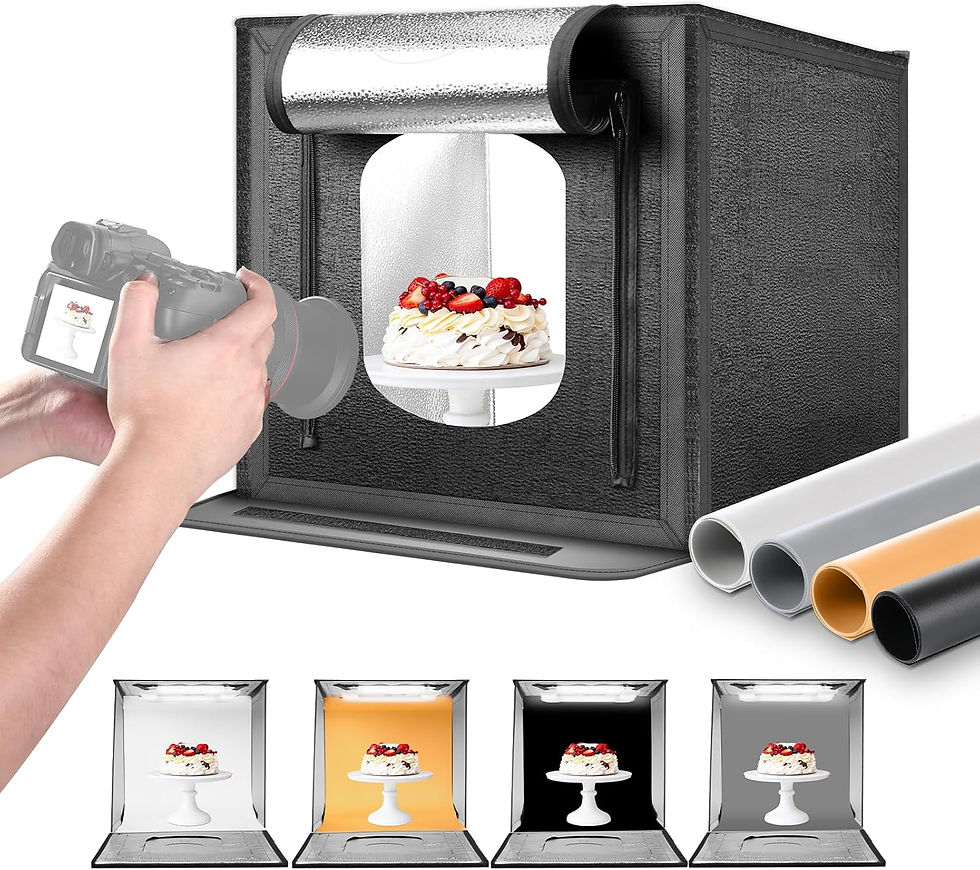
Once you start photographing action figures, extra space becomes much more valuable.
The NEEWER LP50 provides an interior of roughly 20 by 20 by 20 inches, giving you significantly more room to frame figures without having them pressed against the walls of the light box.
NEEWER lists the LP50 with 192 LEDs, 5600K lighting, CRI 97+, TLCI 98+, and adjustable brightness. It also includes front shooting openings and a top opening for overhead photos.
That makes it a better choice for:
6-inch and 12-inch action figures
Anime figures
Funko Pops
Booster boxes
Elite Trainer Boxes
Sealed TCG products
Larger collectible lots
Why We Like It
Much more shooting space than card-focused boxes
CRI 97+ color rendering
192 LEDs
Multiple shooting angles
Four interchangeable backgrounds
Foldable design
What We Don't Like
A 20-inch cube takes up meaningful desk space.
If you mostly sell cards and occasionally photograph one small figure, buying this much room probably does not make sense.
4. NEEWER LP60: Best for Larger Collectibles
The NEEWER LP60 is where we move from convenient tabletop accessory to something you should probably measure for before clicking Buy.
Its interior measures roughly 24 by 24 by 24 inches.
That gives sellers more flexibility for larger figures, statues, boxed collectibles, multi-item lots, and products that simply do not fit comfortably inside smaller light boxes.
The LP60 uses 160 LEDs with CRI 97+, TLCI 98+, 5600K color temperature, and adjustable brightness. NEEWER rates its maximum illumination at 5200 lux from 0.5 meters.
Why We Like It
24-inch shooting area
Good for larger figures and mixed inventory
CRI 97+
Dimmable lighting
Multiple shooting openings
Four backgrounds included
What We Don't Like
It is complete overkill for trading cards.
Do not buy the biggest option because bigger sounds better. Buy it because you actually photograph products that need 24 inches of space.
5. PULUZ Mini Photo Studio: Best Budget Option

If your products are genuinely small, you can keep this simple.
The PULUZ Mini Photo Studio Light Box is designed for small-item photography and is inexpensive enough to make sense for someone just starting to improve their eBay or marketplace photos.
The small footprint makes it particularly suitable for:
Raw trading cards
Graded cards
Coins
Pins
Miniatures
Small accessories
Why We Like It
Small footprint
Easy to store
Built-in lighting
Good match for individual cards and slabs
Lower-cost entry into light-box photography
What We Don't Like
You will outgrow it quickly if you begin selling figures or sealed products.
Buy this because your inventory is small, not simply because the box is cheap.
What Size Photo Light Box Do You Need?
For collectible sellers, size is more important than obsessing over which box has the highest LED count.
A simple rule:
Give yourself some room around the item.
If a 12-inch figure barely fits inside a 12-inch box, you technically solved the size problem while creating a photography problem.
Are Photo Light Boxes Good for Trading Cards?
Yes, but trading cards present one annoying challenge: reflections.
Foil cards, graded slabs, penny sleeves, toploaders, magnetic holders, and glossy product packaging can all reflect the LEDs back toward your camera.
A light box helps because it diffuses and distributes the light more evenly, but it will not magically eliminate every reflection.
For cards, I would start by:
Using the diffuser.
Lowering the brightness if the surface is blowing out.
Moving the camera or card slightly off-axis.
Checking that the foil pattern and surface are still visible.
Do not sacrifice an accurate picture of the card just to make the background perfectly white.
For an eBay buyer, seeing the actual condition and surface of the item matters more.
Does CRI Matter for Product Photography?
Yes, especially when color accuracy matters.
CRI stands for Color Rendering Index. In simple terms, a higher CRI light is generally better at making colors appear naturally compared with a lower-quality light source.
The PULUZ and DUCLUS options researched here advertise CRI values of at least 95, while NEEWER rates the LP50 and LP60 at CRI 97+.
For collectible sellers, that matters when buyers are looking at:
Card artwork
Foil colors
Figure paint
Packaging
Fabric colors
Product condition
You still need sensible camera settings, but starting with good lighting makes the job easier.
What Color Background Should You Use?
For most listings, white is the safest starting point.
It is clean, keeps attention on the product, and works well for most cards and collectibles.
Black can work particularly well for bright or reflective items, while other colors can help separate a similarly colored product from the background.
I would not get too creative for normal eBay listings.
The goal is not to photograph your Pikachu card like it is launching a fragrance campaign. The goal is to let the buyer clearly see what you are selling.



Comments