
The Ultimate PSA Submission Supply List (2026)

The Complete Shopping Checklist to Protect Your Cards and Avoid PSA's Hidden Packaging Penalties
If you're preparing to submit cards to PSA, you've probably already read their official online packaging guidelines. While that guide explains how to package your order, it doesn't actually tell you which specific products are worth your money.
If you are shopping on Amazon, those are the exact questions you need answered. This independent buyer's guide is designed to complement—not replace—PSA's instructions. Think of it as your ultimate shopping checklist for building an efficient, high-yielding submission setup.
Affiliate Disclosure: Some of the links in this guide are affiliate links. This means that if you choose to make a purchase, I may earn a small commission at no extra cost to you.
PSA Submission Supplies at a Glance
Product Type | Required by PSA? | Top Recommended Brand | Why It’s Necessary |
YES | Essential base layer; opaque/matte backs are banned. | ||
YES | Mandatory; rigid toploaders cause processing delays. | ||
YES | Creates a rigid "sandwich" to prevent bending. | ||
YES | Holds the stack together securely without sticky tape residue. | ||
YES | Absorbs transit impacts inside the main box. | ||
YES | Sturdy, minimal empty space to prevent sliding. | ||
YES | Seals seams; masking and painter's tape are banned. | ||
Optional | Saves massive ink costs for labels and paperwork. | ||
Optional | Avoids costly postage guessing mistakes at the post office. | ||
Optional | Spots microscopic dents/scratches before you waste grading fees. | ||
Optional | Estimates if your card hits PSA’s 60/40 visual threshold. | ||
Optional | Cleans holders and work surfaces of grading-killing dust. |
Who Needs These Supplies?
Supply | Beginner (1–10 Cards) | Frequent Submitter (Monthly) | High-Volume Dealer / Flipper |
Required | Required | Required | |
Required | Required | Required | |
Required | Required | Required | |
Optional | Recommended | Recommended | |
Optional | Recommended | Recommended | |
Highly Recommended | Recommended | Recommended | |
Highly Recommended | Recommended | Recommended |
Why the Rules Changed: Ditch the Painter's Tape
For years, the standard advice floating around the card collecting community was to wrap card stacks tightly in blue painter's tape or stick plastic pull-tabs onto penny sleeves. The logic seemed sound: it kept the cards from moving, and painter's tape peels away without leaving nasty adhesive slime.
However, PSA has updated its processing procedures to manage high submission volumes.
PSA now explicitly forbids the use of tape, sticky notes, or pull tabs on individual card holders. When an assembly line grader has to unwrap layers of sticky tape or navigate pull-tabs while wearing gloves, it slows down the entire system. More importantly, trying to slice through tape near a raw card significantly increases the risk of an accidental edge nick or corner crimp.
The current, official standard is simple: stack your cards in order, place them between two oversized pieces of thick cardboard, and secure the bundle with standard rubber bands. The rubber bands should be loose enough to avoid bowing the cardboard, but snug enough to prevent the cards from sliding out the sides.
The Best PSA Submission Supplies: Deep Dive

Every single card must be placed inside a clean penny sleeve before sliding it into a semi-rigid holder.
CRITICAL SUBMISSION WARNING: Do not use Premium, Matte, or colored gaming sleeves for submissions. PSA requires standard, ultra-clear sleeves so the grader can perfectly view the card edges and back without removing it from the sleeve.
Best Overall: Ultra PRO Clear Penny Sleeves (100-Pack or 500-Pack Bulk) — The undisputed industry benchmark. They are perfectly clear, sized consistently, and thin enough to slip easily into semi-rigid holders without jamming.
Best Premium Alternative: TitanShield Clear Sleeves — Excellent clarity and cut consistency, making them a great secondary choice if Ultra PRO goes out of stock on Amazon.
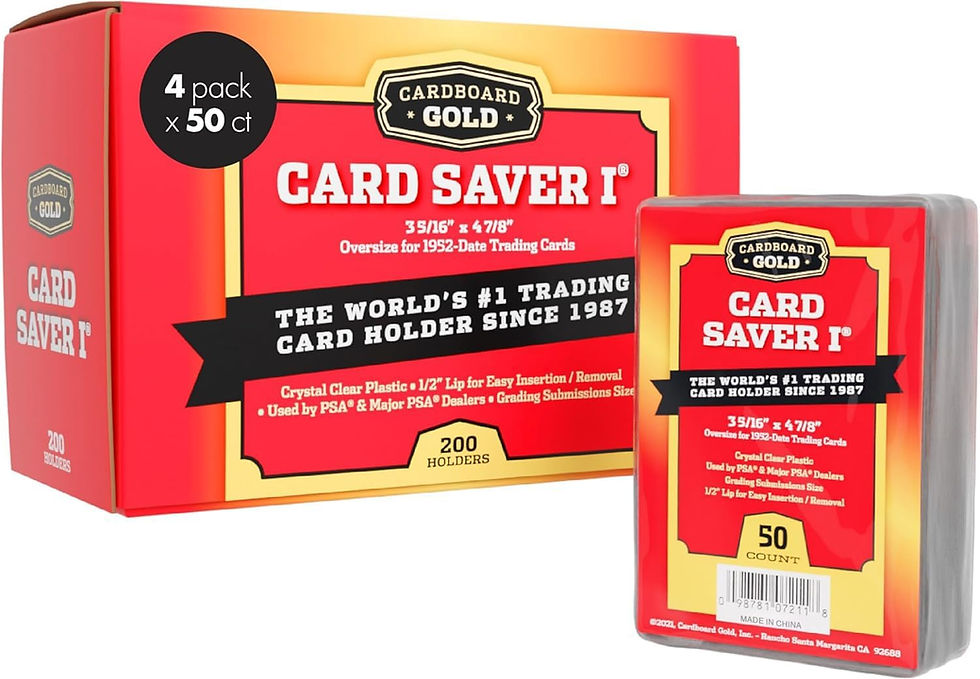
This is the single most critical item on your shopping checklist. PSA strictly requests semi-rigid card holders.
THE TOPLOADER TRAP: Boxed submissions using rigid Toploaders or magnetic cases are actively penalized. PSA explicitly warns that rigid holders slow down their high-volume intake process. Submitting in toploaders can result in a 5% service charge penalty on your entire order and severely delay your processing times.
Best Overall: Cardboard Gold Card Saver I — This is the absolute gold standard for card submissions. They are perfectly sized for standard trading card games (Pokémon, One Piece, Lorcana, Magic: The Gathering) and sports cards. They offer just enough lip to drop the card in smoothly without pinching the corners.
Best Alternative: Ultra PRO Semi-Rigid TCG Holders — Equal in clarity and build quality. Perfect for buying in bulk if you run large monthly submissions.
Why to avoid Card Saver II: Card Saver IIs are noticeably smaller. They are designed for vintage baseball cards. If you attempt to force a modern card into a Card Saver II, you risk dinging the corners or whitening the edges. Stick to Card Saver I.
Stack your Card Saver Is neatly in the exact order of your printed online submission form. Sandwich the stack between two clean sheets of corrugated cardboard, and secure the bundle using 2 to 3 standard rubber bands. Ensure they are snug enough to stop the cards from sliding, but loose enough that they do not warp or bend the cardboard sandwich.

Never let your card stack sit loose inside a shipping box.
Corrugated Cardboard Sheets: Cut or buy pre-sized cardboard panels slightly larger than your Card Savers. This forms an unyielding external shell that protects the bundle from being crushed by heavy packages during transit.
Small Bubble Wrap: Wrap your cardboard-enclosed card bundle in 2 to 3 layers of small bubble wrap. Small bubbles provide much tighter, uniform compression than large bubble wrap sheets, preventing individual cards from shifting.
8x6x4 Corrugated Shipping Box: Do not use bubble mailers, even for a single card submission. Mailers can easily be crushed or bent in automated sorting machines. Use a brand new, rigid corrugated box. An 8x6x4 inch box is the ideal size for most small-to-medium submissions, leaving just enough room for protective bubble padding.
Heavy-Duty Shipping Tape: Seal every seam of your box using high-grade, thick packaging tape. Avoid masking tape, painter's tape, or duct tape, which can peel away under temperature fluctuations in transit vans.
Professional Pre-Grading Tools (The Real Money Savers)

Sending a card to PSA costs a significant amount per card in basic grading fees, plus round-trip insured shipping. If you submit a card that has a hidden surface flaw, you waste that grading fee completely. Investing in these desk tools pays for itself almost instantly by saving you from bad submissions.
Standard overhead room lighting will miss 90% of surface micro-scratches, print lines, and tiny corner indents.
What to buy: A 5X LED Desk Magnifying Lamp with adjustable color temperatures.
Why you need it: Placing your raw card directly under high-lumen, focused light reveals hidden surface dents, faint scratches on vintage holographic foil, and tiny edge-whitening specks that mean the difference between a PSA 10 and a PSA 8.
PSA allows up to 60/40 centering on the front of a card to still qualify for a perfect PSA 10 gem mint grade.
What to buy: A clear, plastic TCG Centering Ruler.
Why you need it: You overlay this transparent grid directly on top of your sleeved card. It allows you to count the border millimeters on the left vs. right and top vs. bottom to calculate the exact mathematical centering ratio before you submit.
The Rule: You should never attempt to chemical-clean, polish, or aggressively wipe raw cards, as this can easily scratch modern gloss finishes or ruin vintage paper stock.
The Right Use: Use an ultra-soft, lint-free Microfiber Cloth to wipe down the inside and outside of your Card Saver holders and desk work surface. Dust particles trapped inside a Card Saver can easily be mistaken for surface flaws by a grader, or worse, scratch the card surface during shipping vibration.
Frequently Asked Questions (FAQ)
Can you use top loaders to submit to PSA?
No, PSA explicitly requests semi-rigid card holders (like Card Saver I) for standard submissions. Toploaders slow down the opening assembly line because they are difficult to safely extract cards from. Submitting in toploaders triggers an additional 5% processing fee charge.
What size box should I use to ship to PSA?
An 8x6x4 corrugated box is ideal for submissions under 50 cards. If you are submitting a massive bulk order of 100+ cards, use the original cardboard box that your Card Saver 1s were shipped in, as it fits the card stacks perfectly with zero empty side space.
Do I need to wear gloves when handling raw cards?
No. Professional card authenticators actually recommend against cotton or latex gloves. Gloves vastly reduce your tactile finger sensitivity, making it much more likely that you will accidentally crimp an edge or drop the card entirely. Clean, thoroughly dried hands offer the safest grip and control.
By keeping these exact materials organized at a dedicated desk station, you turn your PSA submissions from a stressful, disorganized chore into a smooth, professional, and highly profitable assembly line.


Comments